 Tanjore: When one thinks of Tanjore it would be the Brihadeshwara temple that comes to mind. Now coming to think of it, there is more to Tanjore that exists beyond the fort walls that guard the temple. For one, we have old buildings and palaces that dot the landscape which most often go unnoticed.
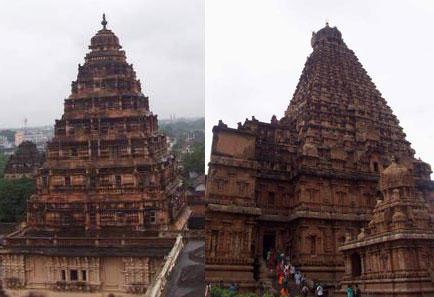
There is something about the Tanjore palace that is of real interest. It is the only surviving example that clearly depicts that large pyramidal towers like the one in this picture were actually used as residential complexes. This means that every floor was occupied by people of the royal family. Adding to this, the top most chamber, at the peak of the tower which houses at the most one room with a path of circum-ambulation to get access to it was probably made exclusively for the king.
Pyramidal towers were nor just constructed, they have been depicted across panels across the south and where do you find them? Well, on relief sculptures of Vaikuntaperumal temple of Kanchipuram, at the shiva temple as well as the amman shrine at Darasuram to mention a few. So how did the ancients even go about something like this and what has it got to do with tanjore temple?
Well, the palace is a residence, which means every level depicts smaller house like structures and when put on one another sequentially make up the whole pyramid so people lived on all the floors. This has a strange background. As most of south indian art owes its past to Buddhist art in the northwest, we need to travel there to see how that affected a temple palace in Tanjore. If we take the buddhist caves of Bedsa and say Karla, we can very clearly see that they tried to depict a village or a group of houses on one single vertical wall. Of course keeping the maturity fo engineering through the ages, the original idea of wanting to live one over the other in a pyramidal structure started here, the pyramid being part of their discovery of architecture. When depicting a whole village on a vertical wall, without perspective in consideration, they tended to pile up all the structures, farthest house coming to the top of the compostion. Series of these smaller houses, architecturally were called shalakutas(broader houses) and karna kutas(narrow houses).
The shalakuta in indian architecture, and more so in the brihadeshwara temple occupy the central area of the main temple tower. all those smaller sturctures you see up there dotting it are shalakutas. the corner structures which are narrower are the karnakutas. Hence Tanjore temple is a depiction, of what a pyramidal palace would have looked like, and tanjore palace of course isthe residential quarters in those days.
Looking further into the tanjore temple itself, it houses the iconography of Shiva profusely on all its walls. Things that we will never get to know or see are the deep dark passages of circum-ambulation this temple hides on its two gigantic floors, and an underground chamber this temple stands on which hosts a world of ancient murals very vulnerable to daylight. So there is really much more than what meets the eye which we just seem to miss no matter how many times we go there. The passages that led up to the higher floors from inside the temple have been blocked with cement for good. The original garbha griha was hollow right through such that if you shood at the shrine and looked up, you could see the top of the tower, way above from inside. This has been blocked by floors constructed over the linga in the Nayaka period. Surely tanjore temple has seen a lot and Tanjore pallace even more.
These are the only surviving examples that show that "rich" people lived in multi-storied buildings, not rectangular but pyramidal in nature. There probably were more of this all around in wood, just the stone structures survive today.